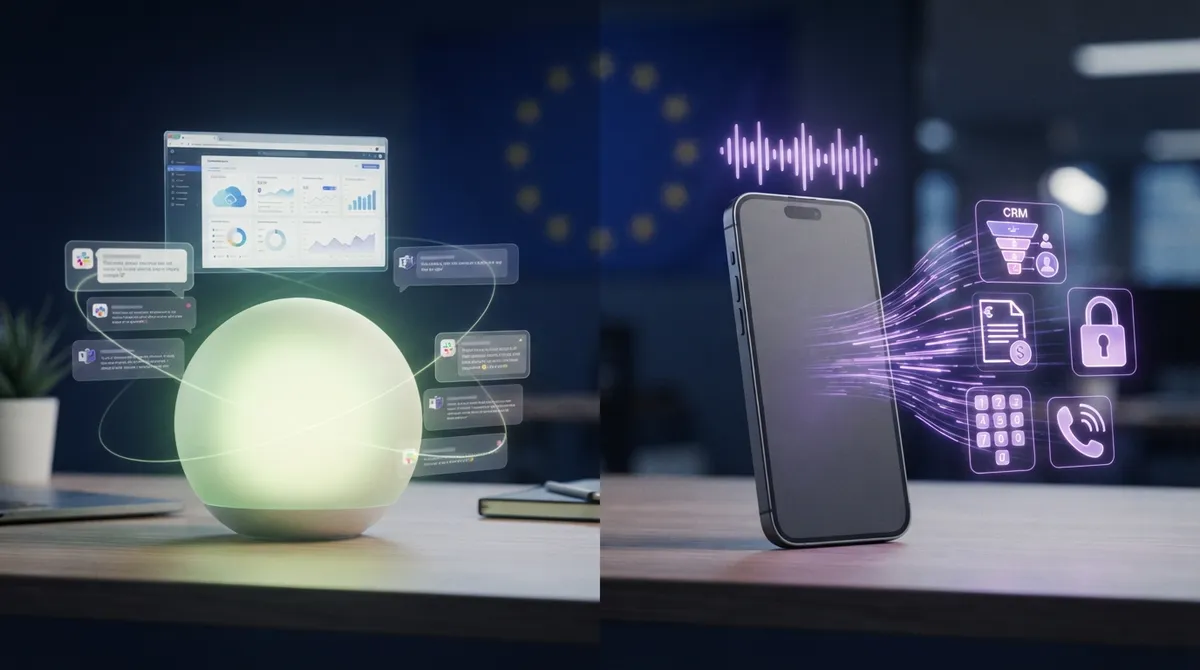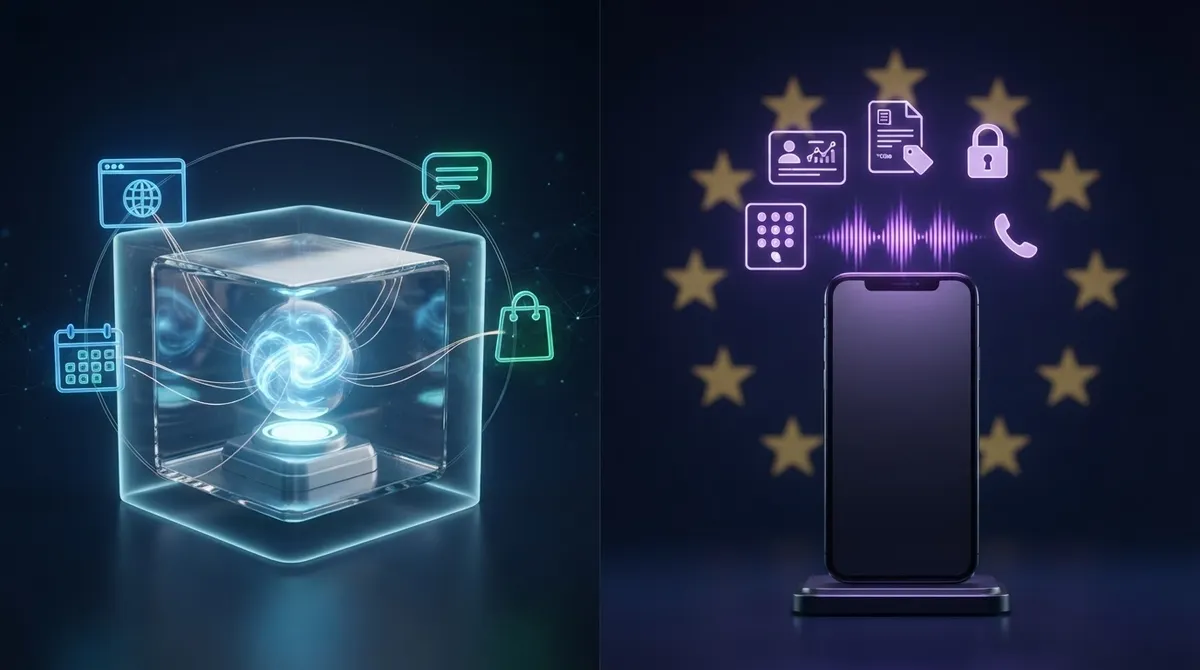
Meta Muse is a personal AI agent (app, muse.ai, WhatsApp) with a Secure VM, connectors and approval before sensitive actions. Muse Wonder (12 Oct 2026) is Meta's frontier model for personal and professional agents. CallMerlin is EU voice-to-SaaS with PIN, phone and minutes from €55/month.
Meta Muse (launched September 2026) is a personal AI agent that acts for you: email, bookings, browser work, shopping and small-business connectors, with approval before sensitive steps. On 12 October 2026 Meta introduced Muse Wonder and Muse Wonder Full: frontier models with Active Memory and Active Focus for personal and professional agentic work, available via Meta Model API and Muse Code (Full for Muse Code subscribers). CallMerlin solves a different moment: someone on the floor, on the road or on the intranet who needs live CRM, accounting or ops tools by phone or chat, with PIN rights enforced on the server before every action.
What Muse (and Muse Wonder) does well
- Personal always-on agent with a dedicated Secure VM and browser per user.
- Channels: Muse app (iOS/Android), muse.ai, WhatsApp; AI glasses announced.
- Connectors for email, calendar, payments, shopping, health and small-business tools (e.g. Slack, Shopify, QuickBooks, Stripe in Meta's small-business expansion).
- Approval before sensitive actions plus a user-facing activity/audit trail.
- Muse Wonder: Active Memory (context across conversations) and Active Focus (persist through blockers, check in before important actions).
- Muse Wonder Full: stronger variant for Muse Code; Muse Wonder via Meta Model API + Muse Code.
- Consumer pricing: free with a limit, Power $20/month (500M Muse tokens/week), Maximum $100/month (3B/week) per Meta Help.
How CallMerlin is different
- Voice-native and phone-first: dedicated PSTN line, hands-free caller verification, WebRTC on the intranet widget.
- Embeddable white-label widget for SharePoint, Confluence or any internal portal.
- PIN users with per-tool rights checked in backend code before every action.
- 80+ deep Merlin connections plus 900+ managed connectors aimed at operational SaaS.
- Desktop app, Android app, call logs, transcripts and minute billing with a budget cap.
- Plans from €55/month on annual billing (2 PIN users), 7-day trial, EU hosting by default.
Overlap: agents that touch tools
Both let people start work in natural language and touch apps. Muse wins when one person wants a personal agent that remembers goals, works in a browser, books or handles small-business tasks after approval, especially where Muse is available. CallMerlin wins when the same operational question must be answered via a business phone line or embedded widget, with individual PIN rights, team roles and EU hosting, without a Meta account as the identity layer.
Muse Wonder versus CallMerlin as a product
Muse Wonder is a model (API / Muse Code), not a B2B voice platform. Meta says Wonder will power Muse experiences and heavier artifact processes, first for subscribers. CallMerlin is not a frontier model to train or host: it is a voice-to-SaaS execution layer with OAuth/BYOK into your tools. Compare Wonder to Grok or GPT as a model choice; compare Muse-the-app to CallMerlin as access channel and rights model.
Channels and rights model
Muse lives in the Muse app, muse.ai and WhatsApp, with a per-user VM and Sentinel-style approval for egress/actions (Meta's security narrative). CallMerlin unifies phone, intranet widget, Windows desktop, Android, Slack, Teams, chat and API under one PIN capability matrix enforced server-side. CallMerlin refuses tool calls the PIN user is not allowed to make, regardless of the prompt. Muse's outbound calling feature (agent calls US businesses) is not an inbound PSTN business line with PIN for your employees.
Availability: US/Canada versus EU
Key fact for NL/EU buyers (Meta Help + coverage, read 13 October 2026): Muse and Muse subscriptions are in limited testing and not available everywhere; public coverage cites the US and Canada. CallMerlin is available for EU teams via callmerlin.app, with primary processing in the EU (Netherlands) by default. Score availability and residency separately when evaluating Muse as a consumer agent and CallMerlin as an EU ops layer.
Hosting, privacy and enterprise controls
Muse documents an isolated cloud VM per user, credentials kept out of agent view, approval before sensitive actions, and claims Muse data is not shared with Meta ad systems. Training defaults and IT admin (SSO, team seats, central export) are weak or absent in public Muse docs: per Meta account, no classic enterprise console. CallMerlin runs primary processing in the EU by default, with AES-256 credential encryption, PIN plus optional 2FA, 90-day call audit and server-side capability checks. EU RFPs should score residency, training opt-outs, named identity and team governance explicitly.
Pricing models compared
Live on Meta Help (read 13 October 2026): Muse free with a usage limit; Power $20/month for 500 million Muse tokens per week; Maximum $100/month for 3 billion tokens per week. Subscriptions renew monthly. Muse Wonder Full sits behind Muse Code; API pricing for Wonder/Spark is on Meta Model API (not the same as Muse consumer seats). CallMerlin sells plans from €55/month on annual billing with included minutes, prepaid packs and overage budget caps, plus a 7-day trial. Model Muse tokens for personal agent tasks separately from CallMerlin minutes for field and intranet ops.
G2 and external reviews
Muse is recent (September 2026); Muse Wonder shipped 12 October 2026. There is not yet a stable G2 product page for Muse as an enterprise comparison. This post relies on Meta's research blog, Meta Help subscriptions and public product coverage, not G2 stars.
Setup and go-to-market
Muse: Meta account, app or muse.ai, connect apps one by one, keep approvals on. Muse Wonder: API or Muse Code for developers. CallMerlin documents a five-step quickstart with server-side PIN rights, optional 2FA and EU hosting from day one.
Choose Muse if
- You are in an available region (today mainly US/Canada) and want a personal Meta agent for bookings, email, browser and small-business tasks.
- Secure VM, WhatsApp access and consumer pricing ($0 / $20 / $100) matter more than EU team PSTN.
- You want Muse Wonder as a model in Muse Code or Meta Model API for agentic coding and personal agents.
- IT does not require a PIN matrix across eight channels or an intranet embed.
Choose CallMerlin if
- Non-desk workers need CRM or finance hands-free by phone.
- IT requires an intranet embed with PIN + 2FA instead of only a personal Meta agent.
- EU-hosted voice ops with server-side rights and call transcripts matter.
- You want predictable monthly cost: minutes plus a cap, not a Muse token meter per employee.
- Muse is not available in your country but voice-to-SaaS still is.
Both at once?
Yes, where Muse is available. Knowledge workers can use Muse for personal or small-business agent tasks while CallMerlin handles field and phone queries on HubSpot, Exact or Moneybird. Split policy: Muse for personal agent workflows; CallMerlin for human-initiated voice ops with named PIN and EU audit.
Capability matrix in plain language
- Personal Secure VM + browser agent: Muse yes, CallMerlin no VM per user
- Muse Wonder frontier model (API/Muse Code): Muse/Meta yes, CallMerlin not a model-hosting product
- Active Memory / Active Focus: Muse Wonder yes (Meta claim), CallMerlin session + knowledge/tools
- WhatsApp + consumer Muse app: Muse yes, CallMerlin WhatsApp not a core channel
- Small-business connectors (Shopify, QuickBooks, Slack, …): Muse yes (Meta claim), CallMerlin 80+ deep + 900+ managed
- Hands-free inbound PSTN business line: CallMerlin yes, Muse outbound agent calls (US) not a team PSTN product
- Intranet embed with WebRTC voice and PIN keypad: CallMerlin yes, Muse muse.ai/app UI
- Android ops voice app: CallMerlin yes, Muse via Muse app where available
- EU/NL availability at writing: Muse limited/US-Canada, CallMerlin yes
- Default primary processing in EU: CallMerlin yes; Muse on Meta infra
- Price: Muse $0/$20/$100 tokens vs CallMerlin from €55/month + minute cap
- Call log + 90-day audit per PIN: CallMerlin yes; Muse user activity trail
Personal-agent marketing versus voice-ops reality
Both use AI coworker language. Success metrics diverge. Score Muse on tasks that continue in a personal VM, bookings after approval and Wonder benchmarks. Score CallMerlin on median seconds from PIN to verified API answer on phone or widget. Score Muse on personal agent and model frontier. Score CallMerlin on channel breadth, PIN enforcement and telephony audit.
Talking points for security review
Ask Meta/Muse for regional availability, training defaults, subprocessors, VM isolation evidence, whether work accounts may connect, and whether central admin/export exists. Ask for the Muse Wonder safety report when it ships. Ask CallMerlin for EU hosting statements, PIN plus 2FA policy, capability gateway, call transcript retention and AES-256 credential storage. Auditors often prefer API writes with a named PIN identity for spoken finance.
Before you sign the order form
Muse proof is an approved personal or small-business task the user already trusts. CallMerlin proof is a field rep updating HubSpot without a laptop. First check whether Muse is live in your country at all. Split budget: Muse/Wonder for personal or developer agent layers, CallMerlin for voice-to-SaaS.
Real-world use cases
Muse and CallMerlin both touch apps. These scenarios show how teams split a personal Meta agent from phone and intranet voice ops.
Scenario 1: Muse books travel, rep calls CRM
A US founder uses Muse to compare flights and book after approval (consumer Muse workflow). Account managers in the NL do not open Muse, because the product is often unavailable there. They call CallMerlin: 'Which deals in proposal have no next activity this week?' Merlin reads HubSpot via API, respects each rep's PIN rights and creates follow-up tasks. Muse owns personal agent tasks; CallMerlin owns spoken ops in the moment.
Scenario 2: Muse Wonder in Muse Code versus PIN on the line
Developers can use Muse Wonder via Meta Model API or Muse Code for long coding or agent tasks (Active Focus, SWE-Marathon-style workloads in Meta's evaluations). CallMerlin is not a coding agent: the employee calls or opens the widget, verifies with PIN, and gets a SaaS answer within rights. Choose Wonder for model/agent engineering; choose CallMerlin for pull queries from phone or intranet.
Scenario 3: $20 Power tokens versus minute cap
Muse Power delivers 500 million Muse tokens per week for $20/month; Maximum 3 billion for $100. CallMerlin bills from €55/month with minutes, prepaid packs and an overage cap. For field teams that call briefly, minutes plus a cap are often more predictable than a token meter across personal agent tasks, especially if Muse is not live in your region.
FAQ
Can we use Muse and CallMerlin together?
Yes, where Muse is available. Many teams keep Muse for personal or small-business agent tasks and CallMerlin for human-initiated voice and chat access to CRM, finance and ops tools. Publish internal policy so work accounts are not silently connected to Muse without IT review.
Does CallMerlin replace Muse Wonder?
No. Muse Wonder is a frontier model for personal/professional agents and coding. CallMerlin is not a substitute for Meta Model API or Muse Code. For 'build this agent workflow in Muse Code' choose Wonder. For 'how many open Moneybird invoices by phone' CallMerlin is the direct path.
Is Muse available in the Netherlands or the EU?
Meta Help says limited testing and not all locations. Public coverage (read 13 Oct 2026) cites the US and Canada. CallMerlin has no Muse regional block: EU teams start via trial on callmerlin.app.
How do Muse approvals compare to CallMerlin PIN?
Muse asks for approval before sensitive actions and shows an activity trail to the user. CallMerlin enforces a PIN rights matrix in backend code before every tool call, across phone, widget, desktop, Android, Slack and Teams. Both keep human control; audit identity differs (Meta account/Muse versus named PIN).
Where is data hosted?
Muse runs on Meta infrastructure with an isolated VM per user (Meta security narrative). CallMerlin runs primary processing in the EU (Netherlands) by default. EU-first RFPs should score residency, training defaults and retention explicitly.
30-minute evaluation checklist
Use this checklist in a trial week. Score each row 1 to 5. Muse/Wonder win rows on personal agent, Secure VM and frontier model. CallMerlin wins rows on phone, intranet embed, PIN enforcement and minute billing.
- Field staff need weekly hands-free PSTN or Android voice
- Intranet embed with PIN is required for non-Muse users
- Personal Meta agent (bookings, browser, WhatsApp) is core
- Muse is available in your country (US/Canada today)
- Muse Wonder as API/Muse Code model is a separate developer need
- One PIN rights matrix must apply on phone, widget and Teams
- Call transcripts and 90-day audit trail are compliance requirements
- Budget fits $20/$100 Muse seats better than mid-market voice plans
- Default EU data residency is required
Typical rollout schedule
Week 1: connect HubSpot and accounting in CallMerlin, three PIN personas, embed widget. Week 2: PSTN, five voice tests. In parallel (where Muse is live): one Muse connector plus one approved task; developers: one Muse Wonder API call in Muse Code. Week 3: compare time-to-answer for field scenarios versus personal-agent adoption.
Does Muse support phone or an intranet widget?
Muse offers app, web and WhatsApp, plus outbound calling features to US businesses in Meta's tests. CallMerlin adds dedicated inbound PSTN, WebRTC widget, desktop, Android, Teams, Slack and API with one rights model. If your RFP lists inbound phone and embed as must-haves, score Muse on those rows.
How does Muse Wonder relate to CallMerlin tools?
Wonder is intelligence in Meta's stack (Active Memory, Active Focus, coding). CallMerlin tools are OAuth/API actions on your SaaS after PIN. They do not compete one-to-one: Wonder may later power Muse experiences; CallMerlin remains the execution layer for EU voice ops.
Week-one trial script
Where Muse is available: one approved Muse task (booking or small-business draft). Give five reps CallMerlin PSTN for live pipeline. Compare whether the personal agent reduces field questions or phone queries remain. The answer shows whether a consumer agent covers field ops.
Typical buying mistakes
Scoring only 'personal superintelligence' slogans without channel fit. Measure Muse/Wonder on personal agent and model; CallMerlin on phone adoption and PIN. Check NL/EU availability first. Do not use G2 as proof: there is not yet a stable Muse enterprise review set.
Short note for the buying committee
Muse is the personal Meta agent (plus Wonder as frontier model). CallMerlin is the voice and intranet layer with PIN and EU-default hosting. Buy on job-to-be-done, not one AI winner.
CallMerlin's eight access channels
Most AI coworkers in this comparison offer one or two entry points, usually a web app, Slack or Gmail. CallMerlin is built as a multi-channel voice-to-SaaS layer: the same PIN user, permissions, tools and conversation history work across every channel below. Your team picks how they reach Merlin; IT configures access once.
- Phone (PSTN): call your dedicated business number, enter your PIN, speak hands-free from any phone, anywhere.
- Intranet & internet widget: one script tag on SharePoint, Confluence or a public subdomain. WebRTC voice plus full chat in the same UI, no telecom charges on top.
- Windows desktop app: floating overlay with Ctrl+Shift+M, same session as the widget.
- Android app: voice and chat on the go, push notifications for direct messages.
- Chat: type discreetly in the widget, desktop or app. Chat and voice share tools, permissions and history; switch mid-session.
- Microsoft Teams: add Merlin as a bot. Ask in a channel or DM with the same capabilities as phone or widget.
- Slack: same bot experience in Slack channels and DMs, not a separate product with fewer tools.
- REST API & webhooks (Professional+): embed Merlin in your own portals, trigger workflows from external systems, receive events.
That breadth is a structural advantage over Slack-only agents (Adapt, Twin), chat-only enterprise AI (ChatGPT Enterprise, Glean) or developer-only voice APIs (Grok Business). Field staff use the phone; desk workers use chat or Slack; IT embeds the widget on the intranet; integrators use the API. One platform, one permission model.
Bottom line
Muse is Meta's personal AI agent with Secure VM, connectors and consumer pricing; Muse Wonder is the frontier model behind it for personal and professional agents. CallMerlin is a voice and intranet layer on your SaaS tools with PIN, phone and predictable minutes, EU by default. Choose Muse for personal Meta agent workflows where available; choose CallMerlin when phone, embed, PIN audit and EU mid-market access matter.