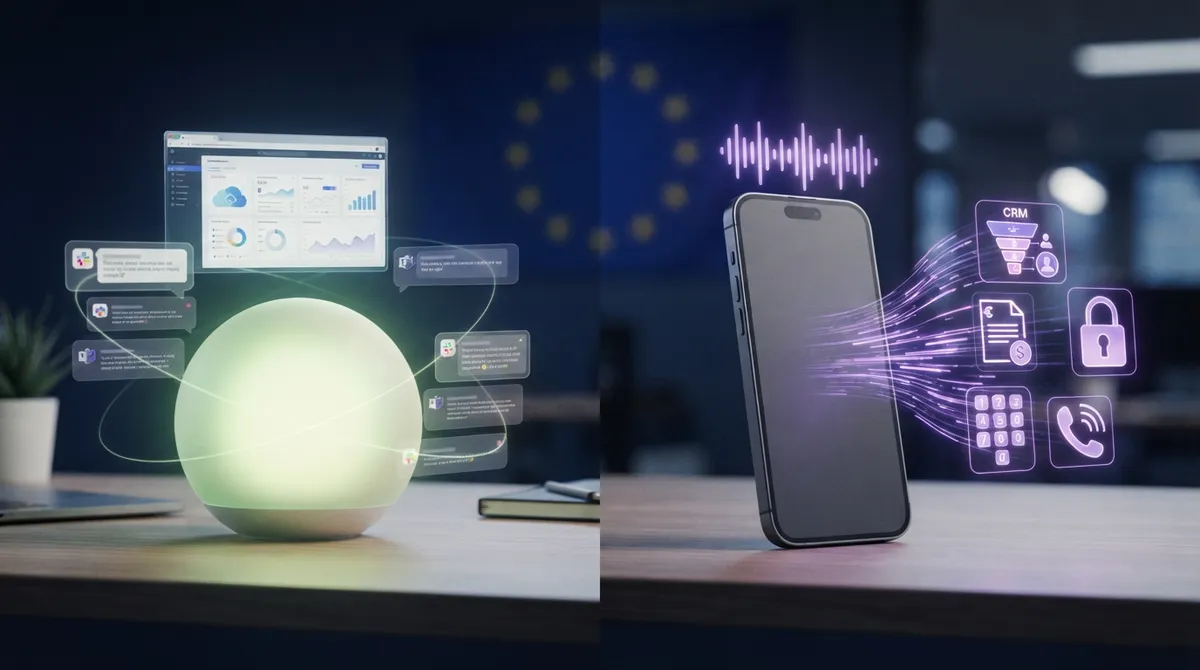
Twin is an autonomous AI employee in Slack and Gmail with 5,000+ integrations and browser automation. CallMerlin adds phone, intranet voice and PIN-secured SaaS access.
Twin markets itself as your autonomous AI employee: it lives in Slack and Gmail, connects to thousands of tools, scrapes and operates websites, and runs proactive agents on a schedule. CallMerlin targets a different moment in the workday, when someone is driving, on a shop floor, or on the intranet and needs live access to CRM, accounting or project tools by voice or chat, with PIN-scoped permissions enforced on the server.
What Twin does well
- Slack and Gmail-native agents: describe a workflow in plain language and Twin builds integrations on the backend.
- 5,000+ app integrations plus browser automation for portals without a public API.
- Proactive agents that ship reports, digests and dashboards before you ask.
- Multi-model routing (Anthropic, OpenAI, open source) for cost and quality per step.
- Triggers, webhooks, scheduled runs and a marketplace to share agents across teams.
What CallMerlin does differently
- Voice-native and phone-first: PSTN line, hands-free caller verification, WebRTC on intranet widget.
- Embeddable white-label widget for SharePoint, Confluence or any internal portal.
- PIN users with per-tool capabilities checked in backend code before every action.
- 900+ SaaS integrations via OAuth/BYOK focused on operational stacks (Moneybird, Xero, HubSpot).
- Desktop app, Android app, call logs, transcripts and minute-based billing with budget caps.
Overlap on automation
Both platforms automate multi-step work across apps. Twin excels when the team coordinates in Slack threads and needs browser agents for legacy portals. CallMerlin excels when the same operational question must be answerable by phone or from an embedded widget without opening Slack or Gmail.
Browser automation vs API voice
Twin can write custom API integrations from natural language and drive websites like a person. CallMerlin deliberately focuses on stable API and OAuth paths with audit-friendly permissions. If your workflow is scrape this login-protected vendor portal, Twin is in its sweet spot. If your workflow is how many open invoices do we have in Moneybird, CallMerlin is the direct path.
When Twin is the better fit
- Slack or Gmail is the hub and @Twin-style agents should run 24/7 in the background.
- You need browser automation for tools that have no API at all.
- Proactive research, prospecting and outreach sequences are the main job.
- Your team wants multi-model routing and credit-based agent economics.
When CallMerlin is the better fit
- Non-desk workers need CRM or finance by phone, hands-free.
- IT requires an intranet embed with PIN + 2FA instead of another Slack bot.
- EU-hosted voice ops with server-enforced permissions and call transcripts matter.
- You want weekly Insights and voice-triggered workflows on live SaaS data, not Slack-first async work.
Can you use both?
Yes. Twin can run proactive Slack automations and browser jobs while CallMerlin handles field voice access to the same stack where APIs exist. Many ops teams split background agents (Twin) from human-initiated voice queries (CallMerlin).
Async Slack employee versus on-demand voice ops
Twin competes as your always-on Slack and Gmail employee that prepares work before standup. CallMerlin competes as the line your driver calls when standup already happened and the CRM still needs updating. Product marketing overlaps on 'AI employee' language, but deployment success metrics differ: Twin measured on automations shipped per week inside Slack, CallMerlin measured on median seconds from PIN entry to verified API answer on phone or widget.
Before you sign the order form
Twin proof of value is proactive Slack output your managers read every Monday. CallMerlin proof of value is a field rep updating HubSpot without opening a laptop. Pilot both if budget allows: one Twin digest workflow and one CallMerlin PIN group on phone plus widget. Compare adoption curves after thirty days. Teams that buy only Twin often discover field staff still call the office for CRM lookups. Teams that buy only CallMerlin still need browser automation for portal-only vendors. Split budget intentionally instead of forcing one marketing narrative to cover both jobs.
Real-world use cases
The table below compares platforms. These three scenarios show how teams actually split Twin and CallMerlin in production.
Scenario 1: Proactive Slack digest plus field CRM access
A 40-person agency runs Twin in Slack to compile a Monday morning pipeline digest from HubSpot and scrape competitor pricing pages overnight. Sales reps in the field do not live in Slack. They call the CallMerlin number from the car: 'Which of yesterday's new leads have no follow-up task yet?' Merlin reads HubSpot via API, respects each rep's PIN permissions, and creates tasks on request. Twin handles async research; CallMerlin handles spoken ops at the moment of need.
Scenario 2: Browser portal automation vs accounting by voice
Finance uses Twin to log into a legacy insurer portal with no API and download PDF statements into Google Drive on schedule. When the CFO asks for open Moneybird invoices while walking between meetings, Twin cannot answer that from Slack without a separate workflow. CallMerlin answers in seconds via phone or the intranet widget chat. Same company, two tools: Twin for browser-only systems, CallMerlin for API-backed accounting.
Scenario 3: One permission model across eight channels
IT embeds CallMerlin on the intranet, enables the Teams bot for desk staff, and keeps the PSTN line for warehouse supervisors. A junior PIN user cannot escalate to admin actions on any channel because capabilities are enforced server-side. Twin's Slack agents inherit workspace access patterns but do not offer phone, widget, Android or a unified PIN model. For regulated EU teams, that channel breadth plus server enforcement is often the deciding factor.
Frequently asked questions
Can we use Twin and CallMerlin together?
Yes. Many teams run Twin for scheduled Slack and Gmail automations and browser jobs, and CallMerlin for human-initiated voice and chat access to CRM, finance and ops tools. There is no overlap conflict if you split background agents from on-demand voice ops.
Does CallMerlin replace Twin's browser automation?
No. CallMerlin focuses on OAuth and API integrations with audit-friendly permissions. For login-protected vendor portals without an API, Twin or Tasklet remains the right category. CallMerlin is honest about that boundary on our compare page.
Why not just ask Twin in Slack from my phone?
Slack mobile works for text, but field staff often need true hands-free voice, caller verification and sub-second access without unlocking apps. CallMerlin's PSTN line and Android app are built for that. Desk workers can still use Slack or Teams bots with the same Merlin session.
Which tool is cheaper for a 50-person team?
Twin uses credit-based agent pricing; CallMerlin uses plan minutes with prepaid packs and budget caps. Compare total cost for users who need daily voice-to-SaaS versus users who only need Slack automations. A mixed rollout is common and often cheaper than forcing one tool to do everything.
30-minute evaluation checklist
Use this short checklist in a pilot week. Score each row 1 to 5 for your team, then compare totals. Twin wins rows about Slack-native proactive agents and browser-only portals. CallMerlin wins rows about phone, intranet embed, PIN enforcement and EU telephony audit.
- Field staff need hands-free PSTN or Android voice weekly
- Intranet embed with PIN is required for non-Slack users
- Browser automation on vendor portals without API is core
- Proactive Slack digests before standup matter more than live CRM queries
- Single PIN capability matrix must apply on phone, widget and Teams alike
- Call transcripts and 90-day audit trail are compliance requirements
- Budget favors credit-based agent runs over minute-based voice plans
- IT prefers one Slack coworker over multi-channel ops layer
Typical rollout timeline
Week 1: connect HubSpot and accounting in CallMerlin, create three PIN personas (sales, finance, ops), embed widget on intranet test page. Week 2: assign PSTN number, run five scripted voice tests per persona. Parallel track: Twin builds Monday digest and one browser portal job. Week 3: compare error rates, permission leaks and time-to-answer for field scenarios. Most mid-market teams decide within three weeks because the channel gap is visible quickly.
Does Twin support phone or intranet widget?
Twin's product surface is Slack, Gmail and related async channels per public documentation. CallMerlin adds dedicated PSTN, WebRTC intranet widget, Windows desktop, Android, Teams, Slack and API with one permission model. If your RFP lists phone and embed as must-haves, score Twin accordingly.
How do proactive agents compare?
Twin excels at scheduled agents that push reports into Slack before you ask. CallMerlin adds scheduled workflows and Insights on connected SaaS plus proactive alerts, but its core strength is human-initiated voice and chat across eight channels. Choose Twin when push-to-Slack automation is the primary job; choose CallMerlin when ops staff must reach systems on demand from phone or intranet.
Week one pilot script
Ship one Twin proactive digest into Slack for sales leadership. Give five reps the CallMerlin PSTN line for live pipeline questions on the road. Compare whether the digest reduces questions or whether phone queries still climb. The answer tells you if async Slack automation alone satisfies field ops or if you need both products.
CallMerlin's eight access channels
Most AI coworkers in this comparison offer one or two entry points, usually a web app, Slack or Gmail. CallMerlin is built as a multi-channel voice-to-SaaS layer: the same PIN user, permissions, tools and conversation history work across every channel below. Your team picks how they reach Merlin; IT configures access once.
- Phone (PSTN): call your dedicated business number, enter your PIN, speak hands-free from any phone, anywhere.
- Intranet & internet widget: one script tag on SharePoint, Confluence or a public subdomain. WebRTC voice plus full chat in the same UI, no telecom charges on top.
- Windows desktop app: floating overlay with Ctrl+Shift+M, same session as the widget.
- Android app: voice and chat on the go, push notifications for direct messages.
- Chat: type discreetly in the widget, desktop or app. Chat and voice share tools, permissions and history; switch mid-session.
- Microsoft Teams: add Merlin as a bot. Ask in a channel or DM with the same capabilities as phone or widget.
- Slack: same bot experience in Slack channels and DMs, not a separate product with fewer tools.
- REST API & webhooks (Professional+): embed Merlin in your own portals, trigger workflows from external systems, receive events.
That breadth is a structural advantage over Slack-only agents (Adapt, Twin), chat-only enterprise AI (ChatGPT Enterprise, Glean) or developer-only voice APIs (Grok Business). Field staff use the phone; desk workers use chat or Slack; IT embeds the widget on the intranet; integrators use the API. One platform, one permission model.
Bottom line
Twin is a Slack/Gmail autonomous coworker with deep automation and browser reach. CallMerlin is a voice and intranet layer on your SaaS tools. Choose Twin for desk-based async agent work; choose CallMerlin when phone, embed and spoken ops matter.