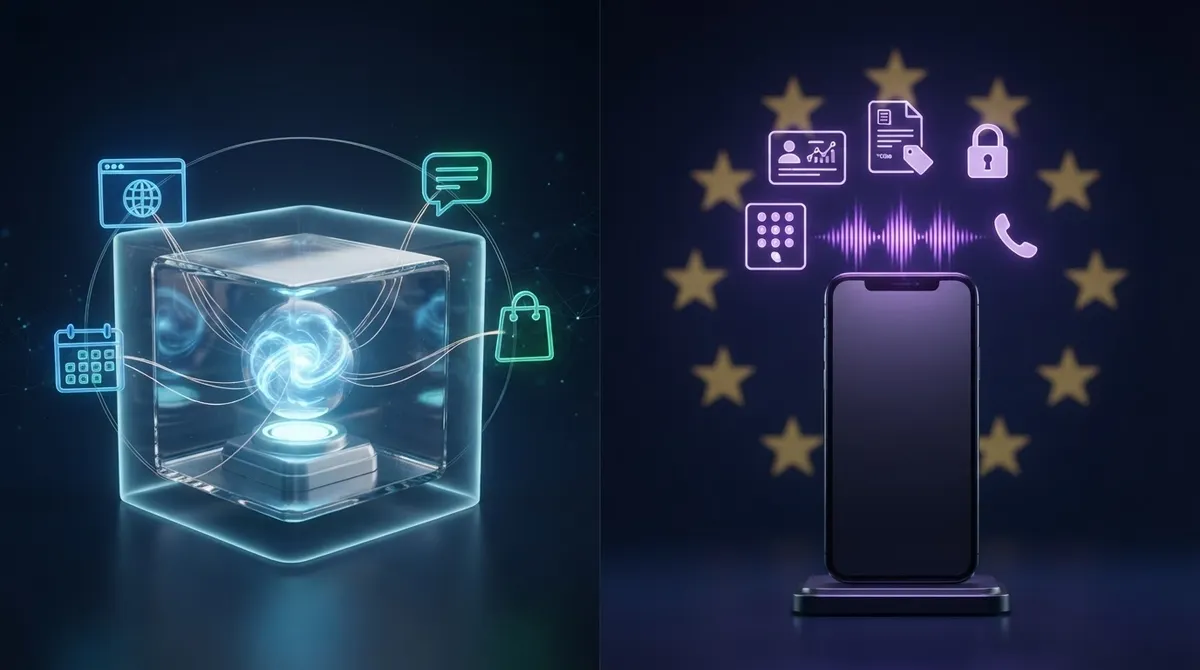
Tasklet agents drive websites and apps without APIs. CallMerlin uses OAuth and APIs for voice access to 900+ SaaS tools. See which approach fits your stack.
Tasklet builds AI agents with a built-in browser: they log into vendor portals, click through admin panels, download files and complete workflows on sites that have no public API. CallMerlin deliberately focuses on tools with API or OAuth integrations, enforced permissions and voice or chat access, not browser automation.
Tasklet strengths
- Automate legacy portals, government sites and dashboards with restrictive logins.
- Persistent browser sessions: human can take over at login, agent continues after.
- Lightweight Chrome-based automation without full cloud VMs.
- Strong for ops tasks like receipt downloads, CMS uploads or Shopify admin pulls.
CallMerlin strengths
- Stable API integrations with encrypted BYOK credentials and audit logs.
- Voice and phone access to CRM, accounting, email and project tools.
- Intranet widget, PIN users, 2FA and server-side capability checks.
- Predictable behavior without brittle UI selectors that break when a site redesigns.
CallMerlin's honest 'not a fit'
We tell prospects openly: browser automation for external sites belongs to Tasklet or n8n, not CallMerlin. If your workflow is 'log into this vendor portal nobody offers an API for', Tasklet is the right category.
When Tasklet wins
- Critical systems only expose a web UI, no API.
- You accept browser-session maintenance for long-running automations.
- Desk-based agents running scheduled browser jobs are enough.
When CallMerlin wins
- Your stack includes HubSpot, Moneybird, Xero, Slack or other API-backed SaaS.
- Field teams need voice, not a browser agent running in the cloud.
- Compliance requires API-level permissions and call transcripts, not screen scraping.
Capability matrix in plain language
- Browser login on vendor sites without API: Tasklet yes, CallMerlin no by design
- OAuth API calls to HubSpot, Moneybird, Exact: CallMerlin yes, Tasklet not applicable
- Hands-free PSTN business line: CallMerlin yes, Tasklet no
- Intranet embed with WebRTC voice: CallMerlin yes, Tasklet no
- Scheduled overnight portal downloads: Tasklet yes, CallMerlin not the primary use case
- Live CRM questions from a car: CallMerlin yes, Tasklet no
- Human takeover during browser login: Tasklet yes, CallMerlin uses PIN plus 2FA instead
- Audit trail on accounting writes: CallMerlin API logs, Tasklet browser session logs
- Breakage risk when vendor redesigns UI: Tasklet high, CallMerlin low on API tools
- Slack and Teams bot for same tools as phone: CallMerlin yes, Tasklet no
- EU-hosted voice infrastructure: CallMerlin default, evaluate Tasklet DPA separately
- Prepaid minute packs and budget caps on voice: CallMerlin yes, Tasklet different pricing model
Why ops teams keep both tools
The mistake is asking which product replaces the other. Tasklet owns the ugly middle of enterprise IT: portals that never shipped an API, admin panels that change CSS twice a year, and downloads that must happen while humans sleep. CallMerlin owns the loud middle of the workday: account managers who will not open a laptop in a parking lot, warehouse leads who need inventory notes read aloud, and finance controllers who want Moneybird totals with a PIN that cannot be social-engineered through a clever prompt. When procurement bundles both into one RFP line item, split evaluation criteria by interface type. Score Tasklet on portal coverage and recovery time after UI changes. Score CallMerlin on channel breadth, PIN enforcement and time from phone call to verified CRM write. Teams that force a single winner usually overpay for browser automation on stacks that already have OAuth, or underfund voice access for staff who never touch Slack.
Security review talking points
Browser automation carries session hijack and credential storage questions your CISO will ask. API-backed voice carries telephony recording, PIN distribution and write-scope questions instead. Document both. For Tasklet, review where sessions run, who can replay browser recordings, and how selector breakage is monitored. For CallMerlin, review capability checkboxes per integration, SMS 2FA policy, call transcript retention and EU hosting statements. Auditors often prefer API writes for accounting because the action maps to a known endpoint with a known identity. Screen scraping can be compliant but requires extra evidence that the automation did not exceed human intent.
Before you sign the order form
Ask both vendors for a reference customer with a similar portal plus field sales mix. Run a joint proof of concept: Tasklet on one legacy download job, CallMerlin on twenty live CRM voice queries from staff who will actually use the phone line. Capture mean time to recovery when the portal UI changes and mean time to answer on Merlin when HubSpot adds a custom field. Procurement teams that only compare slide decks miss the maintenance tax of browser selectors and the adoption tax of forcing field staff into Slack threads. Write into the contract which workflows stay on browser automation and which must use API voice so departments do not debate after budget is committed.
Real-world use cases
Tasklet drives browsers; CallMerlin drives APIs by voice. Smart ops teams assign each tool to the right layer.
Scenario 1: Tasklet for vendor portal, CallMerlin for CRM
Tasklet logs into a carrier portal nightly and downloads CSV rate files to Drive. Account executives call CallMerlin to update HubSpot deal stages and log call notes while commuting. Browser automation handles the portal nobody API'd; voice handles the CRM everyone uses hourly.
Scenario 2: Fragile UI selectors vs stable API writes
Tasklet's built-in browser breaks when a vendor redesigns admin CSS. CallMerlin's HubSpot and Moneybird actions use OAuth APIs with predictable behavior and audit logs. For high-frequency operational queries, API voice beats screen scraping reliability.
Scenario 3: Human handover vs PIN session
Tasklet lets a human take over browser login then continues automation. CallMerlin uses PIN plus 2FA per employee with server-enforced capabilities on every channel. Different security story: shared browser session versus individual PIN identity on each action.
Frequently asked questions
When must we use Tasklet instead of CallMerlin?
When the only interface is a web UI with no API and browser automation is acceptable risk. CallMerlin states this on the compare page and in sales calls. We do not pretend to browser-automate external sites.
Can Tasklet answer voice questions?
Tasklet agents run scheduled or triggered browser jobs in the cloud. CallMerlin is built for interactive voice and chat across phone, widget, desktop, Android, Slack, Teams and API. Interactive field ops favor CallMerlin.
Which has better compliance for finance actions?
API-backed CallMerlin actions with PIN scope, call transcripts and EU hosting typically audit cleaner than browser scraping for accounting writes. Tasklet fits downloads and portal extraction; CallMerlin fits governed CRM and finance ops.
Can one workflow use both?
Yes. Tasklet pulls files from legacy portals; Merlin notifies finance via voice or Slack when totals exceed thresholds using live accounting API data. Compose tools by interface type, not vendor count.
30-minute evaluation checklist
Tasklet automates browsers. CallMerlin automates APIs by voice. Split evaluation by interface type.
- Critical workflows depend on vendor web UIs without API
- CRM and accounting have stable OAuth APIs you use hourly
- Browser selector breakage is acceptable maintenance cost
- Finance writes need API audit trails, not screen scraping
- Field staff need interactive voice, not scheduled browser jobs
- Human browser handover during login is part of the design
- PIN plus 2FA per employee on every channel is required
- Nightly portal downloads to Drive are the main automation
Typical rollout timeline
Tasklet: configure browser agent for portal download, monitor for UI changes weekly. CallMerlin: connect HubSpot and Moneybird, assign sales PINs, go live on phone and widget. Week four: review incident log for broken selectors versus API tool errors. Most teams keep Tasklet on legacy portals and CallMerlin on high-frequency CRM and finance voice.
When is browser automation the only option?
When no public API exists and the business accepts fragility and shared browser session risk. CallMerlin does not browser-scrape external sites. Tasklet owns that layer; Merlin owns API voice ops.
Can Tasklet provide the same eight channels as CallMerlin?
Tasklet runs cloud browser agents on triggers and schedules. CallMerlin provides interactive phone, intranet widget, desktop, Android, chat, Slack, Teams and API for the same employee questions Tasklet was never designed to answer live from a car.
Week one pilot script
Configure one Tasklet browser job for a portal download. In parallel, connect HubSpot and run ten live CRM voice queries from staff who commute. Log Tasklet maintenance time when selectors break versus Merlin answer latency on API tools. Present both numbers to procurement as complementary line items, not competing slogans.
CallMerlin's eight access channels
Most AI coworkers in this comparison offer one or two entry points, usually a web app, Slack or Gmail. CallMerlin is built as a multi-channel voice-to-SaaS layer: the same PIN user, permissions, tools and conversation history work across every channel below. Your team picks how they reach Merlin; IT configures access once.
- Phone (PSTN): call your dedicated business number, enter your PIN, speak hands-free from any phone, anywhere.
- Intranet & internet widget: one script tag on SharePoint, Confluence or a public subdomain. WebRTC voice plus full chat in the same UI, no telecom charges on top.
- Windows desktop app: floating overlay with Ctrl+Shift+M, same session as the widget.
- Android app: voice and chat on the go, push notifications for direct messages.
- Chat: type discreetly in the widget, desktop or app. Chat and voice share tools, permissions and history; switch mid-session.
- Microsoft Teams: add Merlin as a bot. Ask in a channel or DM with the same capabilities as phone or widget.
- Slack: same bot experience in Slack channels and DMs, not a separate product with fewer tools.
- REST API & webhooks (Professional+): embed Merlin in your own portals, trigger workflows from external systems, receive events.
That breadth is a structural advantage over Slack-only agents (Adapt, Twin), chat-only enterprise AI (ChatGPT Enterprise, Glean) or developer-only voice APIs (Grok Business). Field staff use the phone; desk workers use chat or Slack; IT embeds the widget on the intranet; integrators use the API. One platform, one permission model.
Bottom line
Tasklet automates the web UI. CallMerlin voice-enables the API. Many ops teams use Tasklet for legacy portals and CallMerlin for daily CRM and finance questions by phone.